
Key Takeaways
 Accutane often brings long-lasting clearance, but oil output can return and some people relapse, mostly within 2 years.
- In 19,907 patients, 22.5% needed oral acne medicine again and 8.2% retook isotretinoin within about 2 years.
- Relapse was lowest (19.8%) at a total dose of 120–220 mg/kg; a higher daily dose didn't lower it.
Isotretinoin's own label calls its oil-cutting effect temporary. That's Accutane, the acne pill people hope will clear their skin for good. Yet plenty of people finish one course and stay clear long after the last capsule.
So if the oil can come back, how permanent is Accutane, really?
Quick Answer: Is Accutane permanent?
Accutane is the gold standard treatment for acne. The results of a course of Accutane (or isotretinoin) are often long-lasting, but not guaranteed to be permanent. If acne does return, it's usually within the first two years after a course. Honeydew's providers aim for a full cumulative dose, then protect results with maintenance and follow-ups.
Acne is a common skin condition that affects millions of people. For those with persistent acne, including severe acne, finding an effective long-term solution can be challenging.
We'll explore the question: does Accutane work permanently? We'll examine the effectiveness of Accutane, its long-term results, potential side effects, and introduce you to our accessible Accutane care.
What is Accutane and how does it work?
Accutane, also known by its generic name isotretinoin, is a powerful medication used to treat persistent acne, including severe acne. It has gained significant attention for its potential to provide lasting results. According to a 2025 study, Accutane is the only medication that currently works for the long term in treating acne. But how does it achieve this?
Accutane works by targeting the root causes of acne:
- It shrinks oil glands and reduces oil production
- It limits the bacteria and debris building up in your pores
- It reduces inflammation caused by C. acnes bacteria
- It regulates cell turnover
- It reduces keratinization (the process of skin cells sticking together)
By addressing these factors, Accutane treats acne at its source, providing a comprehensive approach to skin health. Our guide to how Accutane works walks through each one.
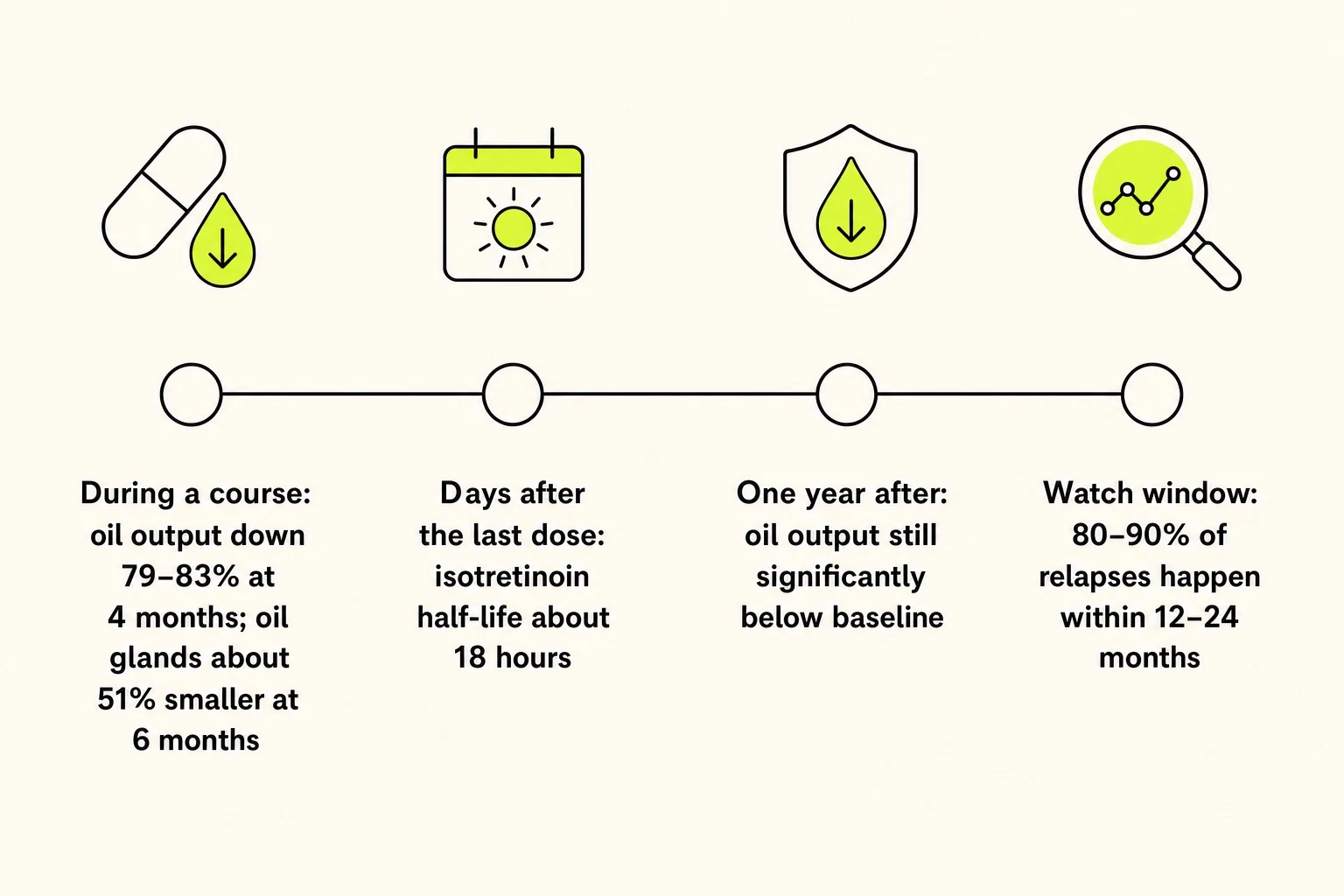
It works long term by changing your skin during the course, not by staying in your body afterward. Isotretinoin's half-life, the time your body takes to clear half of it, is about 18 hours, and its main breakdown product's is about 38 hours. So whatever lasts after a course isn't leftover medicine.
“Accutane is fat soluble which means it may be stored inside fat deposits within your body. After completion of therapy, a small amount is gradually released from the fat cells over time and may enter the bloodstream. This is why Accutane is still present in your system up to a month after completion of therapy.”
— Kimberly Rossi, MD, FAAD | Board Certified Dermatologist
What to expect: Your skin may still be clearing for weeks after you stop, so the label calls for a 2-month wait before restarting.
Does Accutane work permanently on acne?
Accutane is often a lasting solution, but it isn't a guaranteed permanent one. While many people experience long-lasting or permanent results, others may require additional treatments in the future. The question of whether Accutane works permanently is complex and depends on various factors.
Evidence on long-term effectiveness:
- The mechanism: Accutane's mechanism of action suggests potential for long-term results by shrinking oil glands and altering skin cell behavior
- The label: the isotretinoin label reports complete and prolonged remission of acne in many patients
- Dermatologists: the American Academy of Dermatology (AAD) says the clearance can be permanent for some patients
- The limits: a 2025 study followed 19,907 patients for about two years after isotretinoin: 22.5% relapsed, meaning they needed another oral prescription acne medicine, and only 8.2% went back on isotretinoin
Factors that may affect permanence include:
- Individual and hormonal factors: female patients were more likely to relapse than male patients, yet less likely to go back on isotretinoin, and the authors suggest hormonal conditions such as polycystic ovarian syndrome may contribute
- Adherence to the full treatment course: stopping early can leave the total dose short
- Skincare habits post-treatment: relapse after isotretinoin varies widely across studies, from 0 to 69%, but the three studies that kept people on a topical retinoid such as tretinoin, a vitamin A–based cream or gel, landed at 2.9–9.4%
When acne did return, the median time was 7.5 months after treatment, and an estimated 80–90% of relapses happen within 12 to 24 months. Our guide to why acne comes back covers relapse in depth.
Red flag: New deep, painful nodules or fresh scarring in the months after your last capsule are a reason to message your provider soon.
The changes made during treatment are what can last, and the oil glands are the obvious place to look for them.
The Accutane treatment process
In our care, Accutane is typically prescribed for a course of 6-12 months at standard dosing. This extended treatment period for microdosing is designed to provide lasting results by reaching the same full total dose as standard therapy but with less day to day side effects.
During the treatment process, patients may experience initial side effects. It's important to work closely with healthcare providers to monitor and manage any potential side effects throughout the treatment course.
Accutane shrinks oil glands, but it isn’t forever
Not permanently, according to the drug's label, though the effect can last a long time. Accutane shrinks oil glands dramatically during treatment, and in some people oil output stays lower for more than a year afterward. In others, it climbs back to where it started within months.
In one study, oil output fell 79–83% after a four-month course, and biopsies (skin samples) have shown oil glands about 51% smaller after six months. One year after treatment, oil output was still significantly lower than before.
What happens later varies. In a small 1982 study of 20 people, oil output was back to pretreatment levels by 30 weeks in seven of them. In eight others, it stayed 30–80% lower for as long as 80 weeks. The researchers concluded that lower oil output “is not the only actor” behind long-term improvement.
If your skin feels oily again after a course, remember that oil coming back isn't the same as acne coming back.
“During Accutane therapy, oil production decreases and oil glands become smaller, resulting in less oily skin and acne. Months after completing Accutane therapy, the oil glands return close to their original size and oil production. However, Accutane’s long lasting results are because it is affecting the entire follicular unit, not just the oil gland. I tell my patients this is why you may continue to be oily but still less prone to acne. Although oil production revs back up after Accutane, most patients remain a little less oily years later.”
— Kimberly Rossi, MD, FAAD | Board Certified Dermatologist
If oil levels alone don't decide who stays clear, the next question is who tends to relapse.
Does Accutane work for everyone?
No, unfortunately not. Results vary from person to person, both during treatment and in the years afterward. In the primary clinical trial for Absorica (an oral isotretinoin brand), 70% of patients reduced their deep, painful nodules by at least 90% within 20 weeks. However, clearing up once doesn't guarantee permanent remission for every patient. Some people still need gentle topical maintenance (or a second course) to sustain clear skin, especially if they took Accutane before age 16, when ongoing teenage hormone surges can trigger new oil production and breakouts.
The total you take over a course appears to matter more than the pace. This running total, the cumulative dose, is every milligram taken over a course divided by body weight in kilograms. In the 2025 study, a higher daily dose didn't lower relapse, but the total dose made a difference:
| Total Dose Over the Course | Relapsed Within About 2 Years | Went Back on Isotretinoin |
|---|---|---|
| Under 120 mg/kg (low) | 26.1% | 12.7% |
| 120 to 220 mg/kg (conventional) | 19.8% | 5.0% |
| Over 220 mg/kg (high) | 22.2% | 5.5% |
Relapse and retreatment were both lowest in the middle band, and the authors noted that going past 220 mg/kg may not help.
Accutane also isn't only for the most severe cases. The 2024 AAD guidelines strongly recommend isotretinoin for acne that is severe, causes scarring, takes a real emotional toll, or hasn't cleared with standard treatment.
“In my experience approximately 80% of patients who complete a full course of Accutane, will have about 80% long term acne reduction. Relapse rates may be higher in younger patients or patients who have been slower to respond to Accutane and need higher total cumulative doses to clear their acne.”
— Kimberly Rossi, MD, FAAD | Board Certified Dermatologist
The same course that can clear skin for years also carries risks worth knowing about.
Long-term results and potential side effects
While Accutane can provide significant long-term benefits for many users, it's crucial to consider potential long-term side effects as well.
Positive long-term results:
- Clear skin for years: many people stay clear well after their last capsule
- Reduced oiliness: oil output often stays well below its starting level a year after a course
- Effective clearing: many people find that Accutane clears their acne effectively
While Accutane has the potential to provide long-lasting results, maintaining clear skin often requires ongoing care and attention to skincare habits.
Negative experiences:
- Some people experience serious side effects during treatment
- Some people find that Accutane did not permanently clear their acne
- Some people have concerns about potential long-term health effects
These varied experiences highlight the importance of individualized treatment plans and close medical supervision during Accutane therapy.
Potential long-term side effects:
According to a case series published in the Journal of Drugs in Dermatology, some individuals have reported long-term side effects associated with Accutane use. The series analyzed seven YouTube video interviews, so these are self-reported symptoms that continued or began after stopping it. These include:
- Sexual dysfunction
- Neuropsychiatric issues
- Gastrointestinal problems
Nonetheless, these reported long-term side effects are anecdotal, and it remains unclear if they are directly caused by Accutane use. For example, a meta-analysis with about 2.5 million participants exploring the question of potential GI side effects found no evidence that Accutane use plays a role in IBD, Crohn's disease, or ulcerative colitis.
The isotretinoin label still includes a list of some serious side effects:
- Life-threatening birth defects if taken during pregnancy
- Mental health issues, including depression, psychosis, and, rarely, suicidal thoughts
- Increased pressure around the brain (pseudotumor cerebri)
- Inflammatory bowel disease
- Damage to internal organs, including liver and pancreas inflammation
- Sexual side effects, which in some people continue after treatment stops
Because these side effects are serious, it's crucial to discuss all potential risks with a healthcare provider before starting Accutane treatment.
Importantly, the risk of everyday side effects, like dry lips and skin, tends to be lower with lower doses of Accutane, something we offer. A 2025 review of 15 trials found low-dose regimens worked about as well as higher doses, though their long-term relapse rates still need study.
Does Honeydew's Accutane care work?
For results during treatment, the numbers are encouraging. Honeydew surveyed 80 patients who had been subscribed for acne treatment for more than 4 months, and 90%+ of patients reported real results. The survey covered all acne treatments, not only Accutane, and it measures progress during care, not permanence, which no provider can promise.
For those considering Accutane treatment, we offer a convenient and affordable solution. As a company specializing in dermatological care, we provide access to Accutane treatment along with comprehensive support throughout the process.
Why choose Honeydew for your Accutane treatment? Same-day consults are available, ensuring prompt care. Membership includes provider consultations, medication coordination, and progress tracking, plus ongoing support throughout your treatment, so you can message your provider anytime your skin changes. Accutane care starts at $50/month with an annual plan.
With our Accutane care, your provider calculates your cumulative dose target and checks in monthly to monitor side effects, tolerance, and progress. We guide you through every iPLEDGE step (the FDA's required safety program for isotretinoin) and order labs when needed. Your care comes from dermatology providers, including board-certified dermatologists, nurse practitioners, and physician assistants.
Medication isn't included in the membership, but it's as low as $50 a box with an active membership (as low as $30 a box for low dose), or as low as $0 with insurance. You can book a free first consultation, and the membership is eligible for HSA/FSA dollars.
Our approach to Accutane treatment aligns with the goal of achieving long-lasting results. Our providers can help determine if Accutane is the right choice for you and guide you through the treatment process to maximize its effectiveness. By choosing Honeydew, you're not just getting access to Accutane; you're getting a comprehensive acne treatment plan with ongoing support and monitoring. This approach can help increase the likelihood of achieving and maintaining clear skin long after your treatment course is complete.
One Honeydew patient shared this in a review: “I’ve struggled with acne for over 10 years, and nothing has worked quite like Accutane. … I finally feel confident in my skin again, and I can’t recommend it enough!”
Is Accutane the solution against acne, every time?
While Accutane has shown remarkable effectiveness in treating severe or persistent acne, whether its results last permanently doesn't have a simple yes-or-no answer. Roughly 70% to 80% of patients experience long-lasting (or even permanent-ish) clearance after a single course, while others may see breakouts return over time, depending on individual biology and treatment adherence.
“Relapses are also more common in patients with higher testosterone exposure due to polycystic ovarian syndrome, testosterone replacement therapy, and continued use of certain birth control methods that may aggravate acne such as Depo shots and Nexplanon. Relapse rates will always be higher in patients who do not complete a full course of Accutane.”
— Kimberly Rossi, MD, FAAD | Board Certified Dermatologist
Key takeaways:
- Accutane is highly effective at clearing severe or persistent acne that hasn't responded to other treatments.
- Long-term remission is common, with most patients enjoying clear skin for years after finishing their course.
- Individual factors including hormone levels, age, and completing your full prescribed dose directly influence long-term outcomes.
- Both short- and potential long-term side effects should be weighed carefully and discussed with a licensed dermatology provider.
- Close medical supervision and ongoing check-ins, such as Honeydew’s virtual care model, help optimize safety and long-term results.
If you're struggling with persistent or severe acne, Accutane can be a life-changing option for achieving lasting clarity. Still, it's important to begin treatment with realistic expectations and a clear understanding of both its benefits and potential risks. Because every person's skin and hormone profile are unique, pairing a complete course of Accutane with a gentle, consistent post-treatment skincare routine gives you the best chance at enjoying clear, healthy skin for years to come.
Honeydew Recommends
Honeydew's providers plan each Accutane course to reach a full total dose, then protect the results with maintenance and follow-ups. Accutane offers the best odds of lasting clear skin of any acne medicine, but it isn't a one-and-done guarantee.
Our target is 150–220 mg/kg - that's Honeydew's own range, not a guideline, and it sits inside the band tied to the fewest relapses in the 2025 study. With that, we aim to finish the course rather than stop when skin first clears.
After the course, our providers often keep a topical retinoid in your routine. “I routinely add a low dose topical retinoid for appropriate patients to prevent acne relapse post Accutane,” says Kimberly Rossi, MD.
Ensure you keep in touch with your provider through the first year or two because that’s when most Accutane relapses happen. If you restart isotretinoin after 3 or more months off, we treat it as a new course and reset your cumulative dose.
This approach fits people whose acne returns again and again, scars, or has outlasted other prescriptions, whatever its severity. What we can't do is promise acne stays away for good. Isotretinoin also means monthly check-ins, lab work, and, for people who can become pregnant, pregnancy prevention and testing.
Consider exploring Accutane treatment through Honeydew, where you can receive personalized care, ongoing support, and affordable access to this powerful acne solution with one of our dermatologists or board-certified providers. With our providers' expert guidance, you can work towards achieving and maintaining the clear, healthy skin you desire.
If you want Accutane results that last as long as possible, book your free online consultation. If Accutane is a good fit, a provider will build a course around your total-dose goal.
References Cited
- American Academy of Dermatology. (2023, September 12). Isotretinoin: Overview. https://www.aad.org/public/diseases/acne/derm-treat/isotretinoin
- American Academy of Dermatology. (2025, February 11). Skin conditions by the numbers. https://www.aad.org/media/stats-numbers
- Spitz, J. (2026, November 5). What does 'cumulative dose' for Accutane mean? How to calculate and track isotretinoin dosing. Honeydew. https://www.honeydew.com/blog/understanding-cumulative-dose-accutane
- Ghadimi, T. R., Martinez, M. J., & Rieder, E. A. (2023). Self-reported long-term side effects of isotretinoin: A case series. Journal of Drugs in Dermatology, 22(4), 423–424. https://doi.org/10.36849/jdd.2303
- Lai, J., & Barbieri, J. S. (2025). Acne relapse and isotretinoin retrial in patients with acne. JAMA Dermatology, 161(4), 367–374. https://doi.org/10.1001/jamadermatol.2024.5416
- Lin, L., Lin, W., Zheng, Y., & Cai, H. (2025). Effectiveness and safety of different dosing regimens of isotretinoin for acne vulgaris: A systematic review. Postępy Dermatologii i Alergologii, 42(4), 346–353. https://doi.org/10.5114/ada.2025.153322
- Miranti, S. M. (2024). Maintenance acne treatment with topical tazarotene after oral isotretinoin: Overview and case reports. The Journal of Clinical and Aesthetic Dermatology, 17(11–12 Suppl 1), S14–S17. https://pmc.ncbi.nlm.nih.gov/articles/PMC11698500/
- Paichitrojjana, A., & Paichitrojjana, A. (2023). Oral isotretinoin and its uses in dermatology: A review. Drug Design, Development and Therapy, 17, 2573–2591. https://doi.org/10.2147/DDDT.S427530
- Reynolds, R. V., Yeung, H., Cheng, C. E., Cook-Bolden, F., Desai, S. R., Druby, K. M., Freeman, E. E., Keri, J. E., Stein Gold, L. F., Tan, J. K. L., Tollefson, M. M., Weiss, J. S., Wu, P. A., Zaenglein, A. L., Han, J. M., & Barbieri, J. S. (2024). Guidelines of care for the management of acne vulgaris. Journal of the American Academy of Dermatology, 90(5), 1006.e1–1006.e30. https://doi.org/10.1016/j.jaad.2023.12.017
- Strauss, J. S., & Stranieri, A. M. (1982). Changes in long-term sebum production from isotretinoin therapy. Journal of the American Academy of Dermatology, 6(4 Pt 2 Suppl), 751–756. https://doi.org/10.1016/s0190-9622(82)80055-8
- Sun Pharmaceutical Industries, Inc. (2026, August). ABSORICA and ABSORICA LD (isotretinoin) capsules [Package insert]. DailyMed, U.S. National Library of Medicine. https://dailymed.nlm.nih.gov/dailymed/drugInfo.cfm?setid=3ef0cff8-19c1-4441-b780-fca6c7ee1615
- Yu, C.-L., Chou, P.-Y., Liang, C.-S., Chiang, L.-H., Wang, T.-Y., Tu, Y.-K., & Chi, C.-C. (2023). Isotretinoin exposure and risk of inflammatory bowel disease: A systematic review with meta-analysis and trial sequential analysis. American Journal of Clinical Dermatology, 24(5), 721–730. https://doi.org/10.1007/s40257-023-00765-9


Medically Reviewed by
Kimberly Rossi, MD, FAAD
Board Certified Dermatologist